 Barnorama Welcome To The Fun Barn
Key takeaways
- In May 2024, NASA’s Curiosity rover drove over a rock in Mars’ Gediz Vallis channel and cracked it open, revealing yellow crystals of pure, elemental sulfur.
- It was the first time pure sulfur had been found on Mars. Sulfur-bearing salts called sulfates are common there; the pure element is not.
- Two studies published in 2026 offer explanations: trapped ancient volcanic gases, or low-temperature chemistry in acidic water.
- Neither study claims evidence of life. The findings are about Mars’ ancient environment, not biology.
A two-year-old surprise from Mars is back in the spotlight. The Curiosity Gediz Vallis discovery, a field of stones made of nearly pure sulfur, is trending again after new coverage this week summarized two 2026 studies that try to explain how the deposit formed. Here is what Curiosity found, why scientists were so surprised, and what the latest research says.
What did Curiosity find in Gediz Vallis?
On May 30, 2024, Curiosity rolled over an ordinary-looking white rock. The rock broke apart and exposed pale yellow crystals. Using an instrument on its robotic arm, the rover team determined that the crystals were elemental sulfur, according to NASA’s Jet Propulsion Laboratory (JPL).
That was a first. Since late 2023, Curiosity had been exploring a part of Mars rich in sulfates, which are salts that contain sulfur and form as water evaporates. But those are mixtures of sulfur with other elements. The rock Curiosity crushed was made of pure sulfur, something no mission had seen on Mars before.
And it was not a single stone. Curiosity found an entire field of similar bright rocks nearby. A study published in the journal Science in June 2026 put the size of the deposit at about 2,100 square meters, roughly half an acre, and confirmed the sulfur was remarkably pure.
Curiosity’s project scientist, Ashwin Vasavada of JPL, summed up the reaction in 2024: “Finding a field of stones made of pure sulfur is like finding an oasis in the desert.”
Quick facts: the Gediz Vallis sulfur field
- Where: Gediz Vallis channel, on the slopes of Mount Sharp inside Gale Crater
- When found: May 30, 2024
- What: Rocks made of nearly pure elemental sulfur
- Size of deposit: About 2,100 square meters
- Estimated age: About 3.1 to 2.8 billion years
- Fun fact: Pure sulfur is odorless. The rotten-egg smell comes from hydrogen sulfide gas.
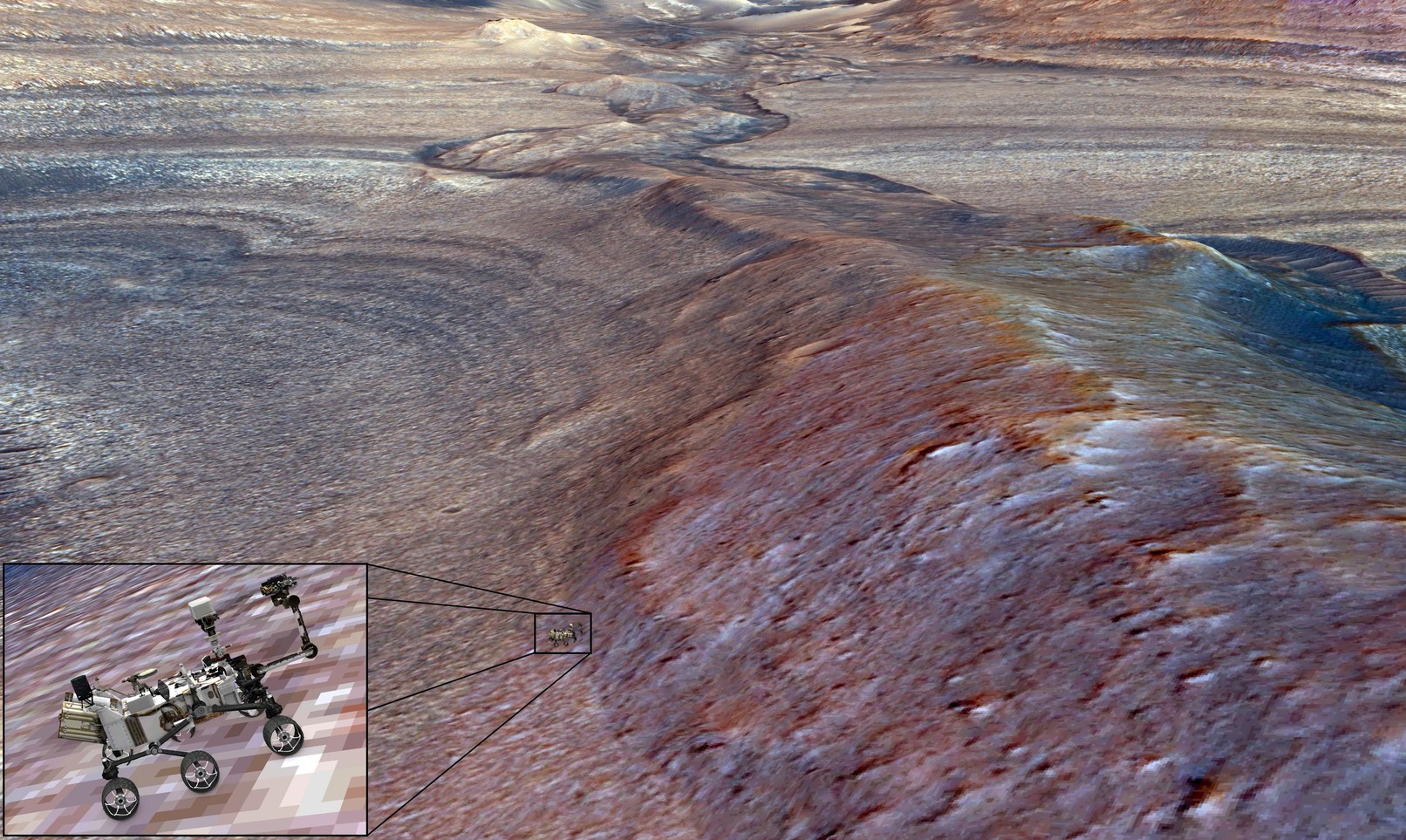
Where is Gediz Vallis?
Gediz Vallis is a channel that winds down part of Mount Sharp, a mountain about 3 miles (5 kilometers) tall in the middle of Gale Crater. Curiosity has been climbing the base of Mount Sharp since 2014. Each layer of the mountain records a different period of Martian history, which is why the rover is there.
Scientists spotted the channel from orbit years before Curiosity launched, and it was one of the main reasons the team wanted to explore this area. JPL says the channel was likely carved by floods of water and debris. Rover observations suggest violent water-and-debris flows built some of the mounds inside it, while dry landslides likely built others.
Why the sulfur was a puzzle
On Earth, large sulfur deposits are usually tied to volcanoes and hot springs. NASA noted in November 2024 that there was no evidence of either on Mount Sharp. The sulfur stones were also too small to be seen by the HiRISE camera on NASA’s Mars Reconnaissance Orbiter, which had shown only a plain, light-colored patch. The rocks were too small and brittle to drill, so the team drilled a larger nearby rock nicknamed “Mammoth Lakes” instead.
Curiosity took a final look at the sulfur field on October 11, 2024, before heading west toward a region of weblike ridges called the boxwork.
Timeline
- 2012: Curiosity lands in Gale Crater.
- 2014: The rover begins climbing Mount Sharp.
- May 30, 2024: Curiosity crushes a rock and exposes pure sulfur crystals.
- June 2024: The team images more sulfur rocks and drills the nearby “Mammoth Lakes” rock.
- October 11, 2024: Last look at the sulfur field before leaving the channel.
- June 2026: Study in Science describes the deposit and proposes a volcanic-gas origin.
- July 2026: Study in Geophysical Research Letters shows a water-chemistry route in the lab.
- November 2026: New coverage summarizing both studies sends the topic trending.
How did the pure sulfur form? Two explanations
Idea 1: Trapped volcanic gases
The Science study, led by planetary scientist Scott VanBommel of Washington University in St. Louis, proposes that sulfur-bearing gases from ancient volcanic activity became trapped underground, possibly inside cage-like ice structures called clathrates. Later, as erosion carved out Gediz Vallis, pressure would have dropped and the gases could escape. Chemical reactions among those gases could then produce pure sulfur without needing high temperatures at the site.
The team also pointed to the fragile nature of the rocks. The fact that one broke under only part of the rover’s weight suggests the sulfur formed where it was found, rather than being carried in from somewhere else. The researchers estimate the deposit formed between about 3.1 and 2.8 billion years ago.
Idea 2: Chemistry in acidic water
A second study, published in Geophysical Research Letters in July 2026 and led by Jiawei Wang of Cornell University, tested a different route in the lab. The team mixed dissolved sulfide with chlorate, a chlorine-and-oxygen compound that may have existed on ancient Mars, in acidic, oxygen-free water at room temperature. The reaction produced tiny crystals of elemental sulfur.
The amount of chlorate mattered. Lower concentrations favored pure sulfur, while higher concentrations produced more sulfate. The crystals in the lab were microscopic, much smaller than the chunks Curiosity found. The researchers noted that the hydrogen sulfide needed for the reaction could have come from the same underground gas reservoirs proposed in the first study, so the two ideas may not be mutually exclusive.
Does this mean there was life on Mars?
No. Sulfur is an essential element for life as we know it, which is one reason the discovery drew so much attention. But neither study claims to have found signs of past Martian life. The lab experiment specifically showed that pure sulfur can form without living organisms.
What the research does offer is a clearer picture of ancient Mars as its climate dried out, and evidence that some fragile rocks can survive almost unchanged for billions of years. That matters for Curiosity’s broader mission, which is to work out whether ancient Mars ever had the conditions needed to support microbial life.
What comes next
Neither study claims to settle the question. Scientists will keep comparing Curiosity’s data with lab work and orbital observations to test both explanations. Meanwhile, the rover has moved on to new terrain, but the Gediz Vallis sulfur field remains one of the most unexpected finds of its long mission.
Sources
- NASA’s Curiosity Rover Discovers a Surprise in a Martian Rock – NASA JPL, July 18, 2024
- NASA’s Curiosity Mars Rover Takes a Last Look at Mysterious Sulfur – NASA JPL, November 18, 2024
- Curiosity Takes a 360-Degree View of Gediz Vallis Channel – NASA Science, 2024
- Curiosity Takes a Last Look at Sulfur Stones – NASA Science, November 19, 2024
- Curiosity cracked a Mars rock and found the planet’s first pure sulfur – Quartz, November 16, 2026
- NASA Curiosity rover finds field of pure sulfur rocks on Mars – Geo News, November 16, 2026
- NASA Curiosity Rover Accidentally Uncovered Pure Sulphur on Mars – IBTimes UK, November 16, 2026
- How Did a Field of Pure Sulfur Rocks End Up on Mars? Two New Studies Offer Answers – Around Prague, November 16, 2026