 Barnorama Welcome To The Fun Barn

Every secure connection your software opens begins with a quiet negotiation. Before any data moves, the two ends agree on a secret key, and that handshake is the part a future quantum computer is expected to break. Two responses have grown up around that risk. One uses physics to share keys, the other swaps today’s vulnerable maths for tougher algorithms. For a developer or tester, the useful question is not which is more elegant but which one lands in your codebase, your dependencies, and your test plan. The change is already underway: as of April 2025, the most widely used cryptographic library turned on a post-quantum handshake by default, so it has reached ordinary build pipelines whether teams planned for it or not.
Key Takeaways
- A quantum computer threatens the key agreement step, not the symmetric ciphers that protect the payload.
- QKD shares keys with hardware and physics; you consume them through a standard API rather than coding the physics.
- Post-quantum cryptography is software, so it is the change most developers will actually ship.
- Standardised algorithms and a hybrid handshake are already built into mainstream libraries.
- Crypto-agility and good test coverage matter more than betting on any single algorithm.
QKD Protocols, Briefly
Quantum key distribution shares a secret key by sending single particles of light, so any attempt to intercept it disturbs the signal and reveals the snooping. Several protocols build on that idea, and knowing the names helps when you read a vendor data sheet. A short tour of the main quantum key distribution protocols sets up everything that follows. The first and most cited is BB84, published in 1984, which encodes bits on the orientation of photons. E91, from 1991, leans on entanglement instead. Later variants tightened security or stretched range, and the table groups the ones you are most likely to meet. Decoy state pulses, for instance, close a practical loophole and now appear in most real deployments, while measurement device independent schemes remove trust from the detectors, a favourite target for attackers.
| Protocol | Era | What it adds |
|---|---|---|
| BB84 | 1984 | Original prepare-and-measure scheme using photon orientation |
| E91 | 1991 | Uses entangled photon pairs to spot interference |
| Decoy-state | Mid-2000s | Closes a laser-pulse loophole; common in real networks |
| CV-QKD | Early 2000s | Continuous variables that suit standard telecom optics |
| MDI-QKD | 2012 | Removes trust in the detectors, a frequent attack point |
Table 1: The QKD protocols you are most likely to see named in vendor and standards documents.
The Standards Layer Developers Actually Touch
While QKD stays specialised, you will almost certainly never build a single-photon source yourself. If an application uses it at all, the software asks a key manager for key material through a published interface, exactly like calling any other service. The European standards body ETSI defines that interface. Its GS QKD 014 specification describes a REST style key delivery API over HTTPS, with requests and responses encoded as JSON, so fetching a key looks like a familiar web call. A lower level companion document, GS QKD 004, covers a more granular application interface, and the International Telecommunication Union has parallel efforts.
For a developer this reframes the whole subject as an integration task rather than a physics project. The habits you bring to any external dependency apply directly: validate inputs and outputs, handle errors and timeouts, and exercise the contract with the right API testing tools before you trust it in production. The quantum part stays inside the hardware, and your code simply sees a key and an identifier it can use.
The Bigger Shift: PQC Is What Most Code Will Use
While that approach stays niche, the change that touches almost every codebase is post-quantum cryptography, or PQC. It keeps everything in software and replaces the breakable maths with problems that quantum machines are not known to solve. In August 2024 the United States standards institute published its first three finalised algorithms, covering one key encapsulation method and two signature schemes. You can read the details in the finalized algorithm standards, but the practical message from the project lead was blunt: do not wait, begin using them now.
Two points make this manageable. First, the symmetric ciphers doing the actual scrambling of your data, together with secure hash functions, are already considered safe against quantum attack, so only two jobs need replacing, which are agreeing on keys and signing. Second, the tooling has caught up. In April 2025 OpenSSL, which underpins much of the internet’s transport security, shipped those algorithms natively in its 3.5 release and made a hybrid handshake its default. A connection between two updated endpoints now negotiates post-quantum protection with no application change at all. Crypto-agility, once a nice idea, is becoming a property your dependencies hand you whether or not you asked.
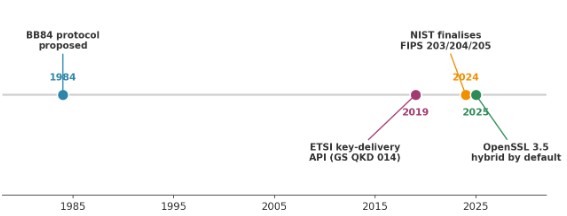
Figure 1: Four decades from the first QKD protocol to post-quantum key exchange shipping on by default.
What Changes in Your Code and Tests
None of this removes the work of getting your own systems ready. The first move is visibility: build a cryptographic bill of materials, a plain inventory of every place your applications and dependencies touch cryptography. You cannot replace what you have not found. The second move is agility. Hard coded algorithm names are the enemy, so pull them into configuration where a future swap becomes a setting rather than a rewrite.
Testing is where most of the surprises live. The new keys and signatures are larger than the classical ones, so handshakes carry more bytes, which can collide with packet size limits, buffer assumptions, and tight timeouts. Interoperability matters too, because a fresh client and an older server must still agree on what to use and fall back cleanly when they cannot. Negotiation logic deserves its own attention, since a downgrade between a modern and a legacy peer is both a compatibility question and a security one, and fault injection helps confirm a connection fails closed rather than open. None of these keys change the final step, which is the ordinary symmetric encryption behind how end-to-end encryption keeps data private; they only protect the moment that key is agreed. Treat the migration as a security feature and bring the same rigour you would to building security into testing.
| A pragmatic starting checklist: inventory your cryptography into a bill of materials, move algorithm choices into configuration, pilot a hybrid handshake on a non-critical service, then measure handshake size, latency, and fallback behaviour before any wider rollout. |
QKD vs PQC: A Developer’s Two-Track View
It helps to hold the two approaches in mind as separate tracks rather than rivals. One is hardware you reach through an API in a few high assurance settings; the other is software you adopt across your whole stack. Many organisations will run both, using the software route broadly and the hardware route for a handful of sensitive links. The comparison below contrasts what each one means day to day, so you can plan the right work for each.
| For a developer | Quantum key distribution | Post-quantum cryptography |
|---|---|---|
| Where it lives | Specialised hardware and a key manager | Your libraries and protocols |
| How you use it | Fetch keys over a REST API | Update a dependency, choose algorithms |
| Standards to know | ETSI GS QKD 014 and 004 | NIST FIPS 203, 204, 205 |
| Main test focus | API contract and key handling | Handshake size, interop, fallback |
| Reach | Niche, high-security links | Broad, almost everywhere |
Table 2: One is an integration you call; the other is a property of the code you already ship.
Wherever you land, the discipline is the same. Prove the change automatically, on every build, by wiring checks into your CI/CD pipeline rather than testing cryptography by hand once and hoping it holds. A negotiated handshake has many branches, and only an automated suite will keep exercising the awkward ones as libraries and defaults keep moving underneath you.
Hybrids and the Open Questions
Most early deployments use a hybrid, pairing a classical exchange with a post-quantum one so the session stays safe as long as either half holds. It is a sensible bridge while the newer algorithms earn trust through real use. Not everyone agrees: some national agencies argue that hybrids add complexity for little gain, while many engineers see that complexity as cheap insurance during a long transition. Standards for signatures and certificates are still moving, so the only safe assumption is that today’s choices will change. That is the real reason crypto-agility keeps coming up, because it is what lets you adapt without another painful migration later.
Frequently Asked Questions
Do developers need to implement QKD themselves?
No. It relies on specialised hardware, so software teams consume keys through a standardised interface such as the ETSI REST API and otherwise treat it as a normal integration. The physics stays in the equipment.
What is the practical difference between the two approaches for a developer?
The hardware route is something you call through a key delivery API in niche, high security settings. The software route, by contrast, is one you adopt across ordinary protocols like TLS, and it is the path most teams will actually ship.
Which post-quantum algorithms should I start with?
Begin with the three finalised in 2024: a key encapsulation method for agreeing on keys plus two signature algorithms. The guidance from standards bodies is to adopt them now rather than wait, since the urgent risk is harvested data being decrypted in the future.
Is a hybrid handshake still safe if one algorithm is broken?
Yes. A hybrid runs a classical and a post-quantum exchange together, and the session stays secure as long as at least one of the two remains unbroken. That property is exactly why it suits the current transition.
How should I test a post-quantum change?
Focus on larger handshake sizes, interoperability between old and new endpoints, clean fallback when a peer lacks support, and performance under load. Run all of it automatically so every build confirms the behaviour rather than a single manual check.
The Bottom Line
The headline sounds futuristic, but the work in front of developers is refreshingly ordinary. The hardware route arrives as an API you call, and the software route arrives as a library you update and a set of algorithms you make configurable. Neither asks you to understand a photon. What they ask for is good hygiene: know where your cryptography lives, keep your choices flexible, and test the change like any other. Teams that build those habits now will treat the quantum transition as a routine upgrade rather than an emergency.
References
NIST, NIST Releases First 3 Finalized Post-Quantum Encryption Standards (13 August 2024) — https://www.nist.gov/news-events/news/2024/08/nist-releases-first-3-finalized-post-quantum-encryption-standards
ETSI GS QKD 014 V1.1.1 (2019), Quantum Key Distribution (QKD); Protocol and data format of REST-based key delivery API — https://www.etsi.org/deliver/etsi_gs/QKD/001_099/014/01.01.01_60/gs_qkd014v010101p.pdf
OpenSSL Project, OpenSSL 3.5.0 Release (8 April 2025) — https://www.openssl.org
IETF, Hybrid key exchange in TLS 1.3 (draft-ietf-tls-hybrid-design) — https://datatracker.ietf.org/doc/draft-ietf-tls-hybrid-design/
Fact Check: All dates, standards, and version details in this article were verified against primary sources (NIST, ETSI, the OpenSSL project, and IETF drafts) as of June 25, 2026. Sources are listed in the References section.